
The swimmers led India's charge on Saturday by winning 7 gold, 1 silver and 1 bronze as they completely dominated the pool yet again.

More than 2,000 activists of various religious and jihadi outfits in Pakistan on Wednesday protested against the visit of Home Minister Rajnath Singh, accusing him for the unrest in Kashmir.

Lekar Hum Deewana Dil struggles to find its own voice, according to Nishi Tiwari.

Will Malik's worldview, shaped by his years with the socialists, Charan Singh, the Congress and V P Singh, help him govern the troubled state? Or would his rule have the imprint of the party he joined in the latter years of his chequered political career?

There are several books that Aakar Patel wishes were being written but aren't. Fortunately, there's plenty coming up this year that he's eagerly awaiting.

Rediff.com's Prasanna D Zore reports from Bhopal and Manikhedi Kot, Etkhedi Kot and Kejra Dev, about the October 30-31 escape and encounter in which 8 prisoners were killed, a case that has many questions and few answers.

The cricket community in Pakistan has reacted cautiously to reports that the Indian and English Boards were willing to play Pakistan at neutral venues with some asking the PCB not to fall in the "trap".

Many in Kashmir believe he needs to stop talking so much. But they are wrong, says Aditi Phadnis. J&K's governor is intelligent enough to know what to say when.
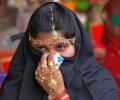
Senior advocate Ram Jethmalani, appearing for one of the victims, was blunt in his arguments and assailed the practice of triple talaq various constitutional grounds including the Right to Equality. "The right of triple talaq is available only to the husband and not to the wife and it breaches the Article 14 (Right to Equality) of the Constitution," Jethmalani said.
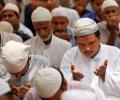
Rahul Gandhi has not erred by not engaging with Muslim conservatives. After all, they had misled his father in 1986 to legislate a misogynistic law after the Supreme Court verdict in the Shah Bano case, which helped the BJP rise at the cost of the Congress, says Mohammad Sajjad.

The seven participants due to represent Pakistan at next month's Games have all been given wildcard entries.
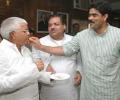
Mohammad Shahabuddin, in prison for over a decade, still inspires fear, a reminder of the 'jungle raj' when political murders were commonplace in Bihar.
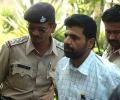
In his petition to the Supreme Court, Yakub had stated that he had been in jail for more than 20 years, which is more than the jail term awarded for life imprisonment, which is 14 years.
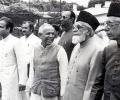
Today as one sees the Owaisi brothers of Hyderabad seeking to lay claim as the custodian of the Muslim vote and the upholders of the community's interests, it is Shahabuddin who springs to mind for having been there, done that, says Saisuresh Sivaswamy.
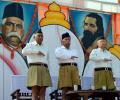
Sangh affiliates believe the government's apparent anti-poor message led to their loss

'Is Ansari flagging a genuine concern? Is a rectification called for?' 'And finally: Do minorities matter?' asks Shekhar Gupta.

'After being a housewife for 13 years and a mother of three, I was put on stage with Shah Rukh Khan! I was trembling on stage and did not know what to do. From singing bhajans with Anup Jalota, I was doing hip-hop and item songs!' Baby Doll singer Kanika Kapoor tells us her inspirational story.

The bench had made it clear that it would examine whether the practice of triple talaq among Muslims is fundamental to their religion.

When the bench asked Sibal 'shouldn't we hear the matter', he replied, 'Yes. You shouldn't.'
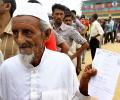
'For the sake of the nation, and the preservation of its polity, it is high time the country's largest political party and the country's largest religious minority make peace between them,' says Saisuresh Sivaswamy.

Delegates of a bilateral peace delegation urge the prime ministers of Pakistan and India to resume dialogue for peace and full normalisation of relations.
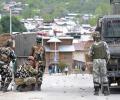
Mehbooba Mufti said that incidents like the ones at Handwara and Nathnusa are "unacceptable" and come as a major setback to the efforts of the state government in consolidating peace dividends in the state.

Non-Congressism is the answer to India's current difficulties, says Dr Shambhu Shrivastava, who gives a historical perspective of non-Congress experiments in 1967, 1977, 1989 and 1998.

'No one talks about the Mumbai riots anymore, though like Delhi 1984, the guilty have not been punished. In Gujarat, many powerful leaders of the state's ruling party are in jail for their role in the riots... In Mumbai, only one politician of the Shiv Sena, a former MP, was convicted of hate speech, along with two other Shiv Sainiks, one of whom was a corporator and the other a junior functionary... So why the apathy? Could it be because despite these statistics and the widely-publicised findings of the Srikrishna Commission, what remained in public consciousness was the violence by the Muslims, thanks to a highly efficient Sena propaganda machine? There's no demand for it, but would an SIT probe into the closed cases of the Mumbai riots help today?' The fadeout of Mumbai's riots from public debate can be called a triumph of the communal State, argues Jyoti Punwani.
 © 2026 Rediff.com - Advertise with us - Disclaimer - Privacy Policy - Sitemap - Feedback - About us - Terms of use - Grievances